

Activities in the Field of Air Conditioning
Air conditioning, also known as thermal environmental engineering, is the science and practice of controlling environmental conditions through the use of thermal processes and systems. Historically, the term “air conditioning” referred mainly to cooling and humidity control. In modern times, however, it encompasses heating, cooling, humidity regulation, and ventilation required to ensure year-round comfort. In other words, air conditioning represents the control of temperature, humidity, cleanliness, air quality, and air circulation to meet human comfort needs within an occupied space. This definition was first introduced by Willis Carrier, the pioneer of modern air conditioning, who achieved the first successful humidity control in 1902 — marking the birth of true environmental control.
For over 20 years, our company has been providing engineering services in the heating and cooling of residential and commercial buildings. These services are divided into two main categories: Natural Gas-Based Air Conditioning Systems and Electric-Based Air Conditioning Systems.
Natural Gas-Based Air Conditioning Systems
Natural gas-based systems are used to heat living and working spaces in homes and buildings. They are preferred due to their affordability, lack of pre-preparation requirements, stable fuel quality, fast and easy start-up, ability to heat all areas evenly, eco-friendliness, and suitability for automatic temperature control, thus ensuring energy efficiency. Common devices include combi boilers, central boilers, and radiant systems.
Among natural gas heating devices for residences and buildings, the most commonly used is the combi boiler. The energy generated from the combustion of natural gas heats water within the device, which is then circulated through radiators to warm the rooms. The combi system operates in conjunction with both water and electrical installations. Below are classifications of the natural gas-based HVAC services we have been providing for over 20 years:
Full Installation: Refers to workmanship services that include combi boiler installation, radiator installation, heating pipework installation, and natural gas piping installation. Heating installations are divided into underfloor (below screed) and above-floor types (full underfloor installation – full above-floor installation).
Partial Installation: Determined by the specific needs of the building. Individual services can be provided separately. For example, if heating pipes exist but radiators are missing, only “radiator installation” may be carried out; or if the gas line exists but no combi unit has been installed, then only “combi installation” is performed. In cases where the request involves only connecting the indoor gas line between the kitchen stove and the balcony combi, the service is classified as “gas connection service.” Workmanship services may thus be categorized as “gas installation,” “radiator installation,” or “combi-gas installation,” depending on the customer’s needs.
Conversion from Central to Individual Heating: When central heating boilers become inefficient or obsolete and refurbishment is not feasible, individual combi systems can replace them. Since radiators and piping already exist in these buildings, “combi installation,” “gas line installation,” and “connection from existing pipework to the combi unit” operations are performed. These procedures collectively constitute “boiler conversion” — transforming central heating systems into individual ones.
Main Gas Column Installation: This refers to the pipeline running from the main service box at the building entrance to the shutoff valves at individual gas meters.
Central Heating (Boiler) Installation: Central systems are installed in multi-residential buildings, complexes, schools, and similar facilities to meet space heating or hot water needs. Modern natural gas boilers have replaced coal-based systems, offering higher efficiency and cost advantages, particularly for shared use. Boilers and burners in such systems ensure even circulation of heated water throughout the building’s entire heating network.
Radiant Systems: Another widely used modern gas-based heating method is the radiant system, which operates using natural gas or LPG. Unlike conventional combi systems that heat the air, radiant systems directly heat objects and people within the space. Frequently used in cafes and restaurants, these ceiling-mounted systems provide rapid heating, offering comfort in a short time while maintaining energy efficiency.
Electric-Based Air Conditioning Systems
Electric-based air conditioning systems are used for both heating and cooling residential and commercial spaces. Devices include split air conditioners, multi-split systems, VRF systems, and heat pumps.
Our company provides sales, installation, and commissioning services for four main types of systems:
- Split Systems: Consist of one outdoor and one indoor unit, typically used in homes and offices.
- Multi-Split Systems: Feature one outdoor unit and multiple indoor units, ideal for larger spaces such as villas, offices, and motels.
- VRF Systems: Comprise multiple outdoor and indoor units and are widely used in hotels, hospitals, and shopping centers with numerous separate zones.
- Heat Pump Systems: Operate on the principle of transferring heat from natural sources such as air, water, or ground using minimal electrical energy. These systems are quiet, eco-friendly, and energy-efficient, making them popular in homes, villas, hotels, and offices. Their use has been rapidly increasing, especially in Europe, due to declining natural gas availability.
HVAC Business Processes
In 2019, our company established its own BPM (Business Process Management) system, named Üçay Process Flow Management (ÜSAY). Below is an overview of how our operational processes function.
Through the ÜSAY system, and in compliance with Turkey’s Personal Data Protection Law (KVKK), more than 270,000 customers have provided consent for communication, according to records from the National Message Management System (İYS).
Based on ÜSAY system data over the past three years — across 25 provinces and more than 50 locations — our company provided HVAC services to 81,147 individual customers: 23,061 in 2021 (out of 42,964 proposals), 29,036 in 2022 (out of 135,704 proposals), and 29,050 in 2023 (out of 100,604 proposals).
With a wide sales network spanning 25 provinces across Turkey, our professional field sales representatives serve customers through both digital inquiries and in-person engagement (distributing print materials, door-to-door visits, etc.).
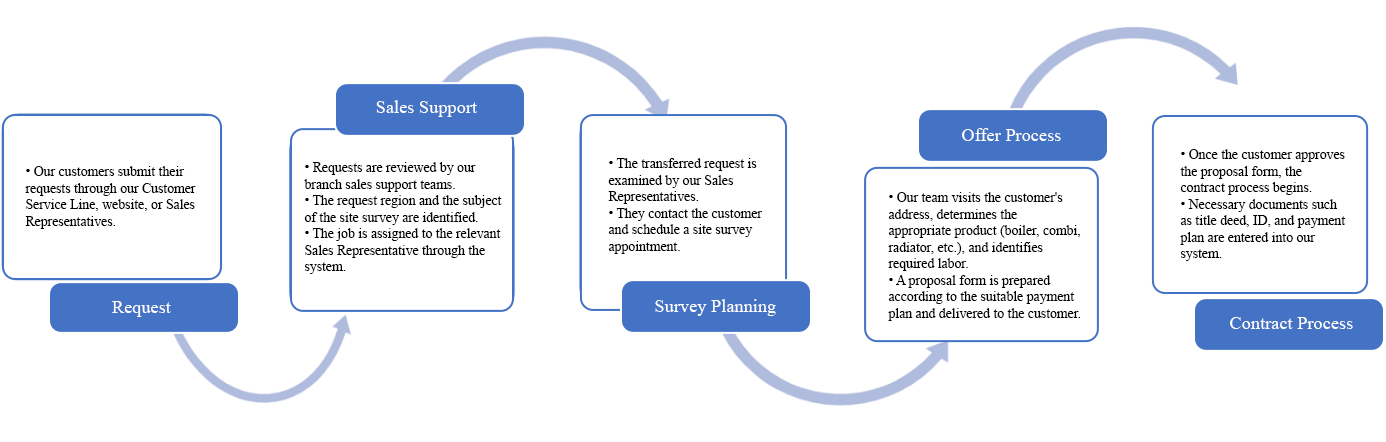
For all potential customers, we provide free on-site surveys and prepare proposals via ÜSAY. Customers who accept proposals are digitally informed about the process in detail. The process flow is illustrated below.
The first stage begins with the customer’s service request and ends with contract signing — typically completed within 24 hours, depending on the customer’s schedule.
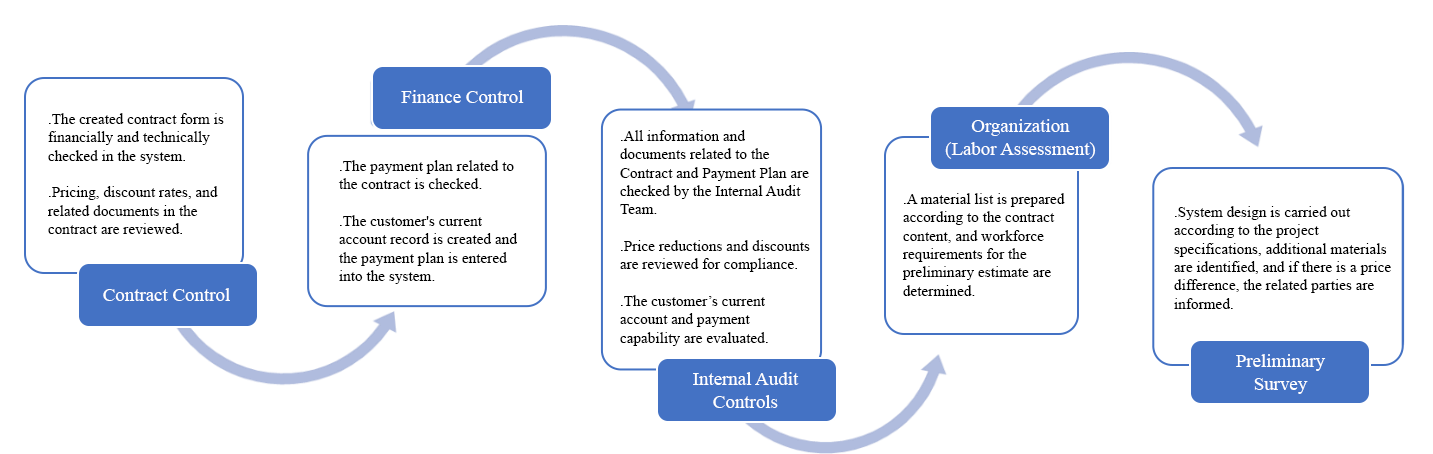
The second stage starts with contract verification and concludes with on-site operational preparations — completed within two business days.
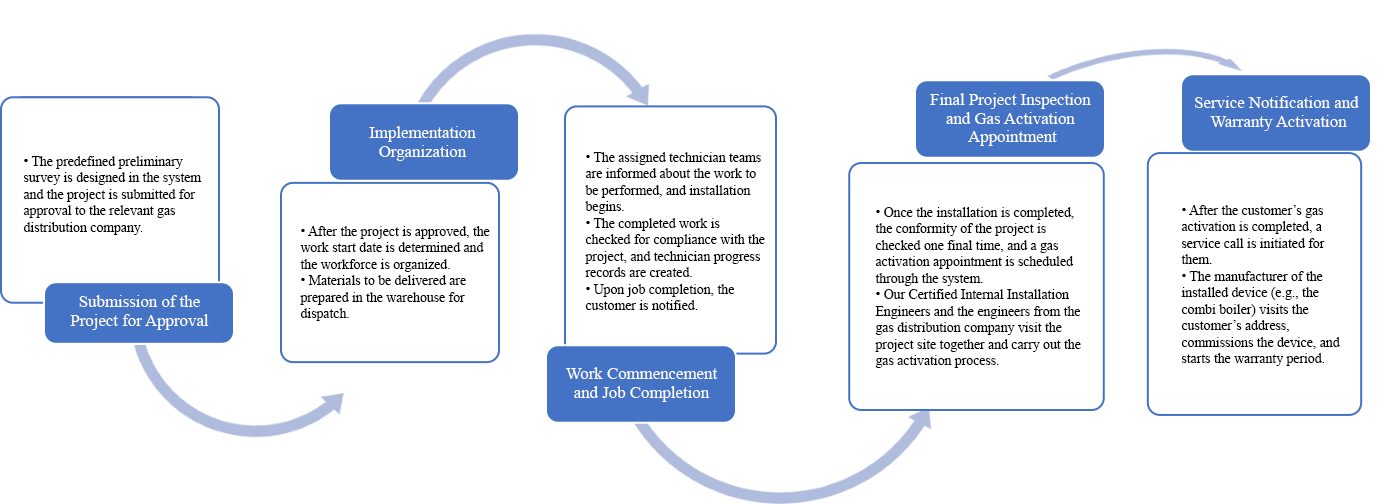
The third and final stage begins with project approval by the regional gas distribution company and ends with the gas activation process. After completion, the device warranty period is initiated through official service notification. Implementation typically takes no more than two business days; gas activation depends on the regional utility’s scheduling.
At Üçay Engineering, we provide sustainable HVAC solutions through environmentally responsible practices. As part of our commitment to leaving a cleaner and healthier environment for future generations, we hold a leading position in the HVAC industry. Our goal is not only to improve indoor air quality but also to enhance energy efficiency and preserve natural resources with every project.
Clean Energy Usage
The foundation of an environmentally respectful approach lies in the use of clean energy. At Üçay Engineering, we aim to reduce our carbon footprint by integrating renewable energy sources such as solar and wind power into our projects. This approach lowers operational costs while protecting natural resources.
Environmentally Conscious Design
In the design stage of HVAC systems, adopting eco-friendly principles is a key priority. Each project incorporates intelligent control systems and high-efficiency equipment to ensure sustainable performance. This not only helps our clients reduce operating costs but also contributes to the preservation of natural resources.
Adding Value to the Future with Green Projects
At Üçay Engineering, we take part in green projects that benefit both the environment and society. Leveraging our expertise in sustainable building design, we create projects that enhance energy efficiency and minimize environmental impact — delivering lasting value to both our clients and the community.